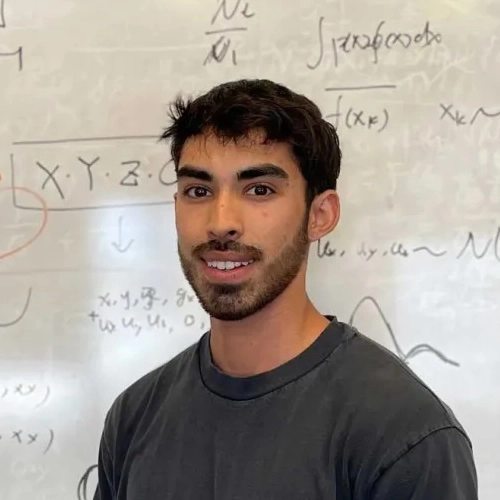
Sebastian "Sebo" Diaz
sebodiaz@csail.mit.edu | sdd@mit.edu | seboddiaz@gmail.com
I am a MIT PhD student working with Prof. Elfar Adalsteinsson and Prof. Polina Golland on machine learning problems.
Research interests
- Incentivizing generalization beyond the training (source) distribution.
- Exploring synthetic data for improved or otherwise unattainable representations.
- Representation learning and optimal use of embeddings.
- Exploiting numerical structure to enhance algorithms.
Funding
I am indebted to the following funding sources (comprehensive list in my CV):- NSF Graduate Research Fellowship Program (GRFP)
- MathWorks Fellowship
- MIT SoE Distinguished Engineer Fellowship
Education
I received my B.S. from the University of Arizona in 2023 where I was fortunate to be mentored by Prof. Arthur Gmitro, Prof. Jennifer Barton, and Prof. Nan-kuei Chen.
News
- Dec 2025Invited MIT IMES Seminar talk.
- Sep 2025Invited MIT IMES Retreat talk.
- Jun 2025MICCAI paper accepted.
- Apr 2024Awarded NSF GRFP.
Publications
Why Invariance is Not Enough for Biomedical Domain Generalization and How to Fix It
Invariance is a common inductive bias for domain generalization. However, we show that it can lead to sub-optimal performance. We propose a simple and theoretically grounded intervention, named DropGen, that exploits invariance and domain-specific information achieving high-sample efficiency and competitive performance.
Robust Fetal Pose Estimation across Gestational Ages via Cross-Population Augmentation
Current fetal pose estimation methods fail to generalize across gestational ages (GA). We propose a novel method to capture lower GA subjects using exclusively higher GA subjects. We achieve state-of-the-art performance on a challenging clinical dataset enabling more accurate motion estimation.
Design of Novel RF Pulse for Fetal MRI Refocusing Trains using Rank Factorization (SLfRank) to Reduce SAR and Improve Image Acquisition Efficiency
Relaxed optimization problem enables significant image acceleration. We show 22% acceleration compared to industry standard with no tradeoffs. Applications in fetal, but pertains to any turbo spin echo sequence.
Fetuses Made Simple: Modeling and Tracking of Fetal Shape and Pose
Analyzing fetal body motion and shape is paramount in pre-natal diagnostics and monitoring. Existing methods mainly rely on keypoints or volumetric segmentations of the fetal body. Keypoints oversimplify the body structure, while segmentation lacks temporal correspondence. To address these shortcomings, we construct a 3D articulated statistical fetal body model based on the Skinned Multi-Person Linear Model (SMPL).
Stochastic-offset-strategy enhanced RF pulse optimization with auto-differentiation
Voxel-wise objective function with auto-differentiation for RF pulse optimization has become prevalent. While benefit from the spatial flexibility of desired pattern, conventional fixed-point representation of a matrix fed into the voxel-wise objective function leads to sub-optimal and undesired resultant profile at courser resolution. We assign random spatial offsets to each point centered at the voxel and show superior performance to fixed-point representations.